AI redefines China's booming micro drama industry
Source: Xinhua | 2026-03-26 | Editor:Doe
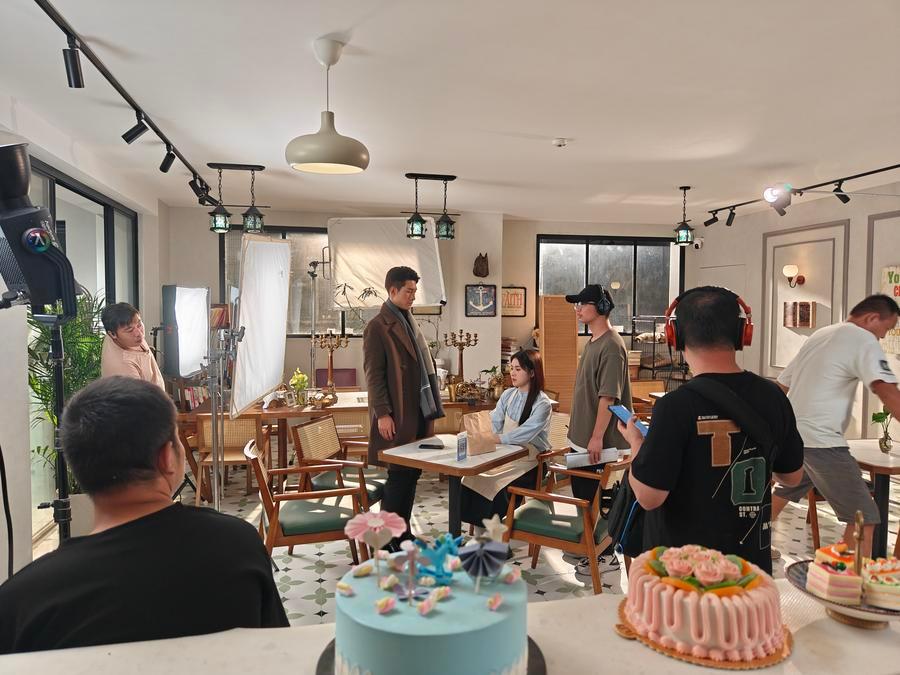
This undated photo shows the filming site of a micro drama at the Shanghai International Short Video Center in Shanghai, east China. (Xinhua)
Micro dramas are captivating global audiences with their fast-paced plots, yet the billionaires and deities whose mere smiles tug at countless heartstrings may not always be portrayed by human actors.
AI-generated micro drama "Feng Shui Tian Shi," meaning master of feng shui, has gone viral since its release last week, amassing over 100 million views within just 12 hours on Douyin, the Chinese version of TikTok.
"It looks so real. I didn't even realize it was AI-generated at first," one social media user commented, highlighting the content's striking lifelikeness.
The hit underscores AI's growing role in micro drama production and its potential to reshape the burgeoning industry.
According to DataEye, a leading industry data platform, AI-generated comic-style micro dramas accounted for an estimated 16.8 billion yuan (about 2.44 billion U.S. dollars) in market share in 2025, and over 10,000 such productions have been released monthly since the start of 2026.
Behind these remarkable numbers lies the rapid advancement of AI technology. In the past, AI-generated images were often criticized as unnatural and inconsistent. Today, however, AI models can produce videos with professional-level cinematography and lifelike characters, with the most advanced systems now achieving a usability rate of over 90 percent for generated footage.
In February, for example, ByteDance released its text-to-video tool Seedance 2.0, which can generate a multi-shot film sequence in roughly 60 seconds with relatively simple prompts, sparking a global craze for AI-generated short videos.
"The breakthrough of tools like Seedance 2.0 has changed not only the efficiency but also the logic of micro drama production," said Jiang Xiaoxiao, managing director of China Insights Consultancy.
His assessment is grounded in reality, as technological advances have dramatically lowered production costs. "A live-action micro drama can cost several hundred thousand yuan, while an AI-generated version of the same length comes in at just over 100,000 yuan, with virtually nothing spent on actors," said a production company in north China's Xi'an.
Inspired by the cost advantages, a growing number of companies have pivoted their business strategies to focus more on the emerging field.
But the shift is casting a shadow over the industry workforce. "Micro drama production traditionally required coordination across many roles, but with AI advancing so quickly, many actors and video editors now risk losing their jobs," said Mimi (pseudonym), a seasoned industry professional.
Despite the disruption, some industry insiders remain optimistic. Ms. Lu, who works at a film and television company, acknowledged that AI-generated micro dramas are bound to capture a share of audience attention and impact the industry. Still, she believes live-action productions will endure.
"Each format has its own audience," Lu said. "Just as micro dramas won't replace long-form series, AI-generated ones won't entirely take the place of live-action productions."
Chen Caiying, a micro drama producer, echoed that view. She noted that different types of micro dramas have distinct strengths. "AI-generated ones are best suited for genres that demand heavy special effects, like sci-fi and fantasy," she said. "But live-action is still the better choice for scenes that require vivid performances and delicate emotion."
"The best approach moving forward is to integrate AI tools with live-action production," Chen added.
As the industry grapples with the impact on traditional production models, it is also seizing new opportunities.
Tang Jili, executive producer of "Feng Shui Tian Shi," pointed to the potential of AI-generated micro dramas to promote Chinese culture globally. He said he hopes his expertise as a filmmaker can help address the storytelling gaps that still exist in the field.
"AI has opened up new possibilities. We can tell good stories through visuals that anyone can understand and deliver them in dozens of languages and markets at once," he said. "It's helping us push the boundaries of creativity."
Young newcomers are also bringing fresh energy to the space. Zhang Haohua, born in 2002, said AI has empowered him to pursue his dream of becoming a director. "As a fresh graduate, I don't have the resources to put together a production crew. But with AI-generated micro dramas, I have the chance to create my own work," he said.
Xia Lie, head of the School of Cultural Creativity and Media at Hangzhou Normal University, called for greater focus on high-quality content. "Whether a drama is created by AI or performed by real actors, a good story and a strong IP will always be the foundation of a hit."
You May Like
-
Culture helps strengthen exchanges
During a visit to the Palace Museum in Beijing in January, veteran guide Wang Xiaoxin had the opportunity to give visiting Finnish Prime Minister Petteri Orpo a...
InKunming 2026-03-19 -
Sour soup from Guizhou makes a splash overseas too
While its strange scent may put some off at first, its bright red hue hints at a thrilling taste adventure of sour and spicy flavor. Yet once you hold your nose...
InKunming 2026-03-17 -
World Insights: Ancient Chinese academies foster cross-cultu...
As the world seeks ways to engage in dialogue across different civilizations while preserving distinct identities, "shuyuan," or ancient Chinese academies, have...
InKunming 2026-03-17 -
Scenery of snow-covered mountains in China's Qinghai
The mountains covered in snow beneath the blue sky present a magnificent scene on the plateau
InKunming 2026-03-16 -
Storytellers in sand and stone
In the hushed halls of the Junsheng Sandstone Paintings Creative Space, the walls do not shimmer with oil paint or float in washes of ink. Touch the vividly col...
InKunming 2026-03-16 -
View of rapeseed flower field in Tongnan, China's Chongqing
InKunming 2026-03-13 -
InPics | Spring greets China with blooming nature
As spring gradually unfolds across China, buds emerge on branches and flowers bloom, attracting people to step outdoors and embrace the nature.
InKunming 2026-03-13 -
Sino-Thai youth deepen ties through study tour
Standing inside the reconstructed caves at Geological Museum of Guizhou, Pongkhun Adulyatham found himself surrounded by towering stalactites and centuries of g...
InKunming 2026-03-11 -
Guizhou artisan weaves new life into bamboo
Yang Changqin turned a childhood passion into a lifelong profession.
InKunming 2026-03-11 -
Spring scenery in Nanning, S China's Guangxi
InKunming 2026-03-10