Sour soup from Guizhou makes a splash overseas too
Source: China Daily | 2026-03-17 | Editor:Flynn
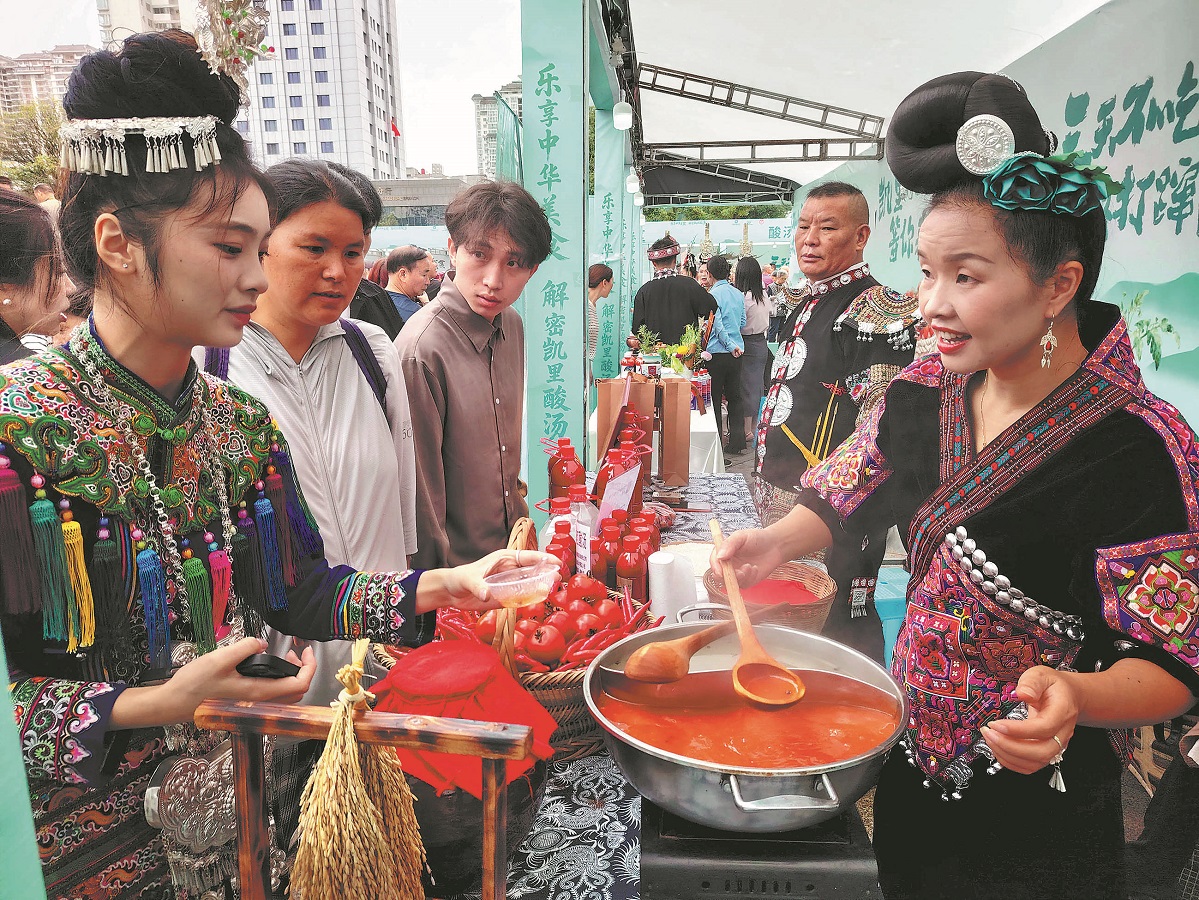
Visitors sample sour soup cuisine at a Kaili sour soup industry development conference in Qiandongnan on Oct 18. Ning Jian/For China Daily
While its strange scent may put some off at first, its bright red hue hints at a thrilling taste adventure of sour and spicy flavor. Yet once you hold your nose and take a sip, you may find yourself craving a second and third bowl.
Kaili sour soup, a signature delicacy from Guizhou province, is increasingly tantalizing the taste buds of food lovers around the world.
As food blogger Ahmed Mohammed Jaber Alkalthoom said in a video: "That acidity — one sip, an unforgettable taste. You'll want to come back for more."
Originating from the Qiandongnan Miao and Dong autonomous prefecture in Guizhou, whose capital is Kaili, the soup reflects culinary wisdom passed down by local people for more than a thousand years.
The red soup is made through natural fermentation of local specialty maolaguo, a type of wild tomato, while the white version is fermented from rice. Blended with spices such as chili and litsea cubeba and aged slowly over time, it develops a rich, mellow sour aroma with a refreshing, slightly sweet aftertaste.
"There is an old saying in Qiandongnan: 'Three days without sour, and you'll walk unsteady for sure. 'Sour soup is an indispensable part of our daily diet," said Zheng Peikun, a deputy to the 14th National People's Congress and Party secretary of Tashan village in the prefecture.
Zheng traced the region's love of sour flavors to earlier times when salt was scarce, prompting residents to rely on fermentation for seasoning.
"Over decades, they remained in good health," he said.
The production technique of sour soup has been inscribed on the intangible cultural heritage list. Beyond a daily dish, it also serves as an important cultural symbol for festivals, banquets and ceremonies honoring distinguished guests.
Sour soup is most commonly used as the base for hotpot. Well-known dishes include sour soup fish and sour soup beef. But for Zheng, now in his 40s, sour soup pig's feet evokes childhood memories.
"Back then, beef and mutton were not as abundant as they are today," he said.
What excites Zheng even more is the soup's growing popularity outside the province and the development of a full industry chain supporting local livelihoods. In 2025, the total output value of the sour soup industry chain across Qiandongnan reached 8.15 billion yuan ($1.18 billion), a year-on-year increase of 221.4 percent, according to authorities.
Several companies are accelerating overseas expansion.
Guizhou Yumeng Food (Group)Co has exported sour soup products, including soup bases and instant sour soup rice noodles, to Vietnam, Thailand, South Korea, Australia, the United States, Canada and Spain, with export value reaching 4.2 million yuan.
Shi Xunzhu, the company's deputy general manager, said order volume reached 18 million to 20 million yuan in January alone, about 30 percent higher than usual levels.
"Not only is the domestic market booming, but overseas orders are also rising. This reflects our accelerated efforts in international expansion," Shi said.
In 2025, Yumeng achieved a comprehensive output value of 534 million yuan. For 2026, the company has set a target of 650 million yuan, with overseas expansion as a key growth driver.
The company has also partnered with restaurants in Milan, Italy, to develop sour soup-flavored spaghetti, which has received positive feedback.
Offline Guizhou sour soup restaurants have appeared in cities including New York, Ho Chi Minh City, Bangkok, Phnom Penh, Kuala Lumpur, Madrid and Melbourne.
In Silicon Valley in the US, Chen Yuzhu, who runs a restaurant featuring Guizhou cuisine, said sour soup dishes are the most popular items on the menu.
Chen Yang, founder of Qiandaren Restaurant, said the brand opened in Ho Chi Minh City in January, a major tourist destination in Southeast Asia with a large Chinese community.
"People here crave the taste of home, and our rich, aromatic sour soup also fits well with local flavors," he said. "We hope to share it with more international friends and let the world experience the charm of Guizhou's food culture."
During this year's two sessions, sour soup was mentioned multiple times by NPC deputies.
Zhang Jizhi, an NPC deputy and director of the Guizhou Provincial Department of Agriculture and Rural Affairs, described sour soup as a natural source of probiotics and antioxidants that stimulate appetite and aid digestion.
Xu Lin, an NPC deputy and Party secretary of Guizhou, said sour soup is visually appealing, refreshing and widely loved.
"We should make it more accessible to dining tables across the country," he said.
Zheng said he once saw foreigners trying sour soup during the Village Super League, a grassroots soccer tournament, and was amused by their reactions.
"They may hesitate at first, but after tasting it, the feeling will surpass their expectations," he said.
Zheng believes the dish has strong potential for globalization and suggested that governments provide greater financial and policy support to help the industry expand internationally.
You May Like
-
History on the plate
Why do Chinese people eat dumplings during the winter solstice? Was egg-fried rice once considered a dish reserved for emperors?The answers to these questions c...
InKunming 2026-01-23 -
In pics: Year-of-the-Horse-themed gold products
Year of the Horse-themed gold products are now available.
InKunming 2026-01-21 -
China Focus: Southeast Asian tourists flock north, fueling C...
Despite the biting minus 20 degrees Celsius cold on the century-old Central Street in Harbin, northeast China's Heilongjiang Province, Thai tourist Nattapong ...
InKunming 2026-01-20 -
Scenery of plum, wintersweet blossoms in winter
Wintersweet blossoms are seen in China.
InKunming 2026-01-19 -
Bamboo slips tell stories of ancient eras
The Jingzhou Cultural Relics Protection Center has developed core technologies to tackle the challenges in restoring waterlogged bamboo and wooden slips, and un...
InKunming 2026-01-15 -
Stitch by Stitch: Jin Huizhen’s Half-Century Devotion to Tr...
In a quiet home in Chenggong District, sunlight streams through the windows onto the balcony. Seated at a table, Jin Huizhen, a recognized inheritor of Chenggon...
InKunming 2026-01-12 -
Global dialogue as fine as porcelain
Artists of Dehua county receive support in their works going overseas, as they innovate the centuries-old craft known as 'ivory white'.
InKunming 2026-01-09 -
China Focus: Heartbeat chronicles: travels that left their m...
An immersive odyssey into the boundless world of Taoist philosophy, few experiences are more soul-soothing than a ticket to the live show at Mount Longhu, or Dr...
InKunming 2026-01-09 -
Tomb rekindles Chu history
Lavish burial reveals monarchy's splendor, vulnerability and struggles on the eve of imperial unification.
InKunming 2026-01-09 -
Across China: How SW China mountain county stitches its way ...
From the Wuling Mountains to pitches across the world, Wuchuan's footballs are about more than just a game. They are also driving and inspiring a small county's...
InKunming 2026-01-08