Trust, dialogue highlighted at forum
Source: China Daily | 2026-09-16 | Editor:Flynn
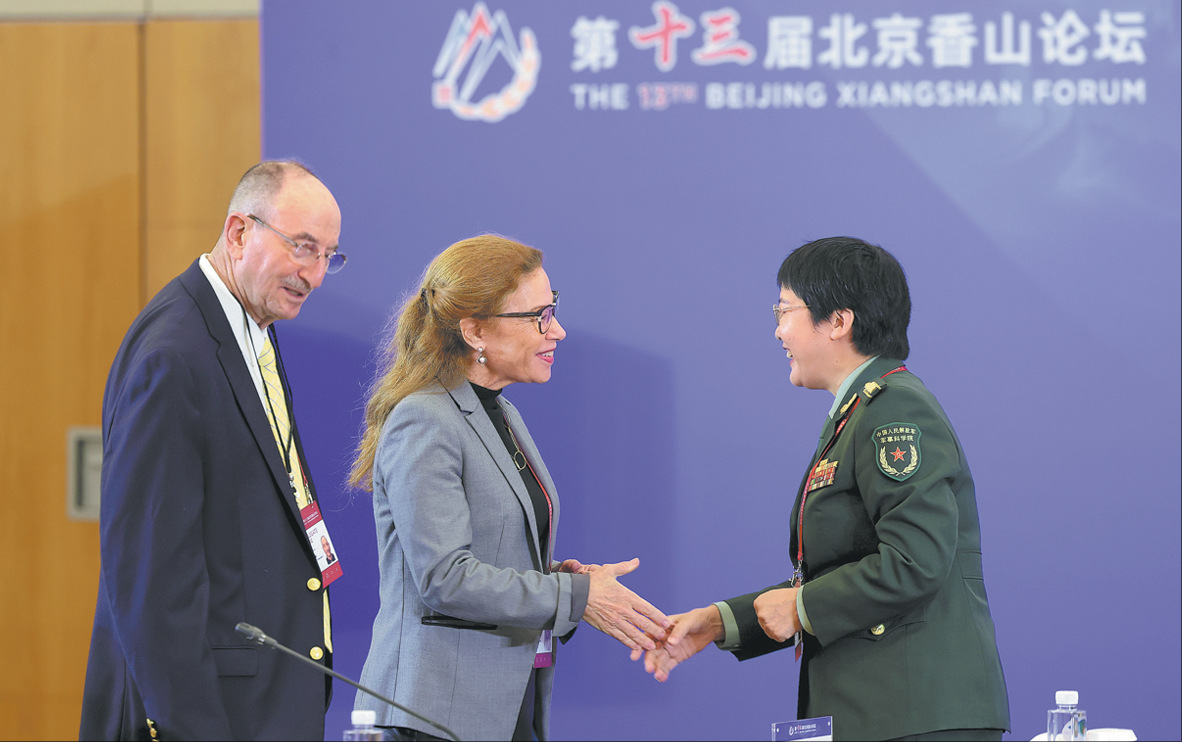
Senior Colonel Li Shuyin, director of the 13th Beijing Xiangshan Forum Secretariat Office, shakes hands with a foreign guest ahead of a side event at the forum on Tuesday in Beijing. Running through Thursday, the three-day forum is themed "Build Consensus on Stability, Advance Security Governance Together". It brings together nearly 100 official delegations from countries, regions and international organizations. This year marks the 20th anniversary of the Beijing Xiangshan Forum. WANG ZHUANGFEI/CHINA DAILY
Experts and officials called for greater trust, dialogue and cooperation amid growing uncertainties in the international environment at the 13th Beijing Xiangshan Forum in Beijing on Tuesday.
Speaking at parallel sessions of the forum, experts from various countries said that the international landscape is experiencing profound changes and multilateral institutions need to adapt in order to remain relevant and effective in addressing emerging challenges.
Carlos Branco, former director of cooperation and regional security at NATO International Military Staff, said the evolution of the United Nations system has been marked by insufficient mutual trust and goodwill.
He pointed to several "loopholes" in the current international system, including unilateral sanctions and tariffs, as well as the use of force outside the framework of international law.
Francisco Cafiero, director of Argentina's Manuel Ugarte Institute of International Affairs and Political Studies, said that the international community needs greater trust and dialogue amid rising uncertainties.
Branco said that the Global Governance Initiative proposed by China provides a new perspective on addressing these problems, highlighting principles that are also fundamental to the UN Charter — the rule of international law, multilateralism and respect for sovereignty.
"This is what the world needs," Branco said. If humanity wants to move forward, rather than fall into global confrontation, and avoid conflicts between major powers, countries need to adhere to these basic principles, he added.
He said that the initiative reflects China's desire to uphold the post-World War II international order, rather than establish a new one.
Cafiero said the initiative aims to provide greater certainty to the world. Regarding growing inequality around the world, he highlighted China's experience in eliminating extreme poverty in 2020, saying that countries of the Global South could learn from China's practices and work together toward the goal of eradicating extreme poverty.
The Beijing Xiangshan Forum, which runs from Tuesday to Thursday, has brought together nearly 100 official delegations from countries, regions and international organizations. This year's forum is themed "Build Consensus on Stability, Advance Security Governance Together".
Yusne bin Hj Mokhtar, chief executive of the Malaysian Institute of Defence and Security, called on multilateral institutions to adapt to the evolving international environment in order to remain relevant, responsive and effective in addressing new challenges.
He said that effective multilateralism should be inclusive, rules-based and grounded in international law, while respecting the sovereignty and strategic choices of every country.
"The real value of multilateralism is demonstrated not when we agree on everything, but when countries with different perspectives are still able to manage differences peacefully and cooperate where they are converged," Yusne said.
Equality emphasized
Yukio Hatoyama, former Japanese prime minister and president of the East Asian Community Institute, said equality among countries in the international community should be ensured to realize multilateralism.
"Countries should act according to rules rather than strength, and we must also ensure that all countries have a role in the process," he said.
Experts at the forum also called for new international rules and frameworks to govern emerging fields, particularly artificial intelligence.
Hatoyama said that against the backdrop of the growing use of AI in military operations, "we are witnessing a form of warfare in which the attacker may not even see the blood or the faces of those who are suffering".
He emphasized that the international community needs to establish new regulatory frameworks for emerging technologies and that international treaties should take into account the use of AI.
You May Like
-
China Focus: China's innovation offers more opportunities fo...
InKunming 2026-09-09 -
Global food system faces mounting resilience crisis
InKunming 2026-09-08 -
China pledges to advance biodiversity protection
InKunming 2026-09-08 -
Institute of Global Development welcomes first doctoral stud...
InKunming 2026-09-08 -
Chinese vice premier calls for closer China-Russia regional ...
China and Russia should strengthen synergy between the Belt and Road Initiative and the development of the Eurasian Economic Union, and further align China's ...
InKunming 2026-09-04 -
China culture-tourism expo opens with over 2,500 exhibitors
The 2026 China Culture & Tourism Industries Expo opened Thursday in north China's Tianjin Municipality, attracting more than 2,500 culture and tourism enterpris...
InKunming 2026-09-04 -
China's annual IP conference to highlight high-quality devel...
The 15th China Intellectual Property Annual Conference (CIPAC) will be held from Sept. 8 to 9 in Beijing, highlighting the high-quality development of the IP ...
InKunming 2026-09-03 -
Xi, Peng Liyuan visit Grand Egyptian Museum
Chinese President Xi Jinping and his wife, Peng Liyuan, visited on Wednesday the Grand Egyptian Museum accompanied by Egyptian President Abdel Fattah El-Sisi ...
InKunming 2026-09-03 -
Xinhua Headlines: Xi, Japarov chart new course for China-Kyr...
Chinese President Xi Jinping said here on Monday that China stands ready to work with Kyrgyzstan to deliver more practical cooperation outcomes that are tangi...
InKunming 2026-09-02 -
Xinhua Headlines: Xi calls for SCO to strive for higher qual...
Chinese President Xi Jinping said on Tuesday that China is ready to work with all parties to continue to strive for higher quality development, and make the g...
InKunming 2026-09-02