Chinese EVs gain ground in South Korea
Source: China Daily | 2026-08-06 | Editor:Flynn
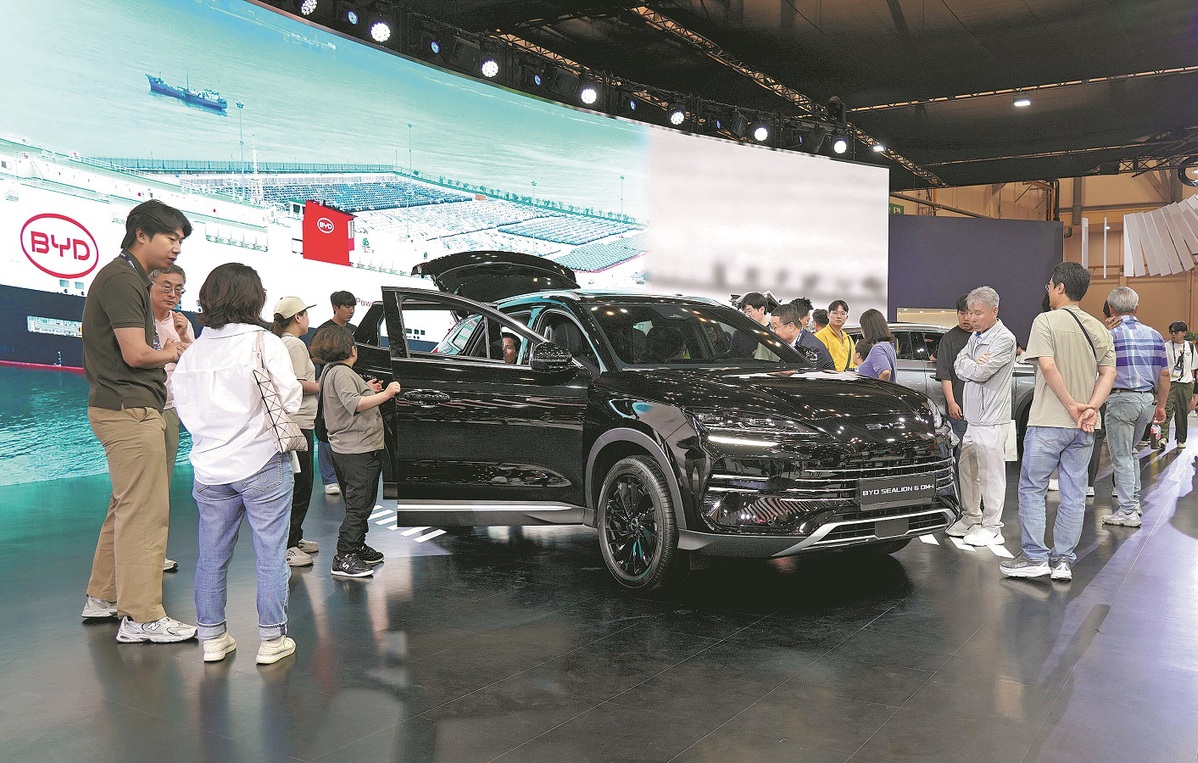
View of BYD's booth during an expo in South Korea in June. XINHUA
Chinese-made electric vehicles are rapidly gaining ground in South Korea, showing the competitiveness and export resilience of China's EV supply chain as consumers there look beyond established brands for affordable, technology-rich models.
South Korea registered 69,513 China-made EVs in the first half, up a whopping 178.7 percent from a year earlier, said a report released on Tuesday by the Korea Automobile &Mobility Association, or KAMA.
This has brought their share of all new EV registrations to 35 percent from 26.8 percent a year earlier, meaning that more than one in every three EVs newly registered in the country came from a Chinese factory.
The development is also reshaping South Korea's wider import market. Registrations of all China-made imported vehicles — including both electric and conventional models — climbed 127.8 percent to 79,444 in the first half, KAMA said.
Notably, their share reached 41.2 percent by manufacturing origin, overtaking Germany for the first time.
The figures measure where vehicles were produced rather than the "nationality" of their brands. Shanghai-made Tesla vehicles accounted for much of the increase, while BYD's mass-market models and China-made premium vehicles added huge momentum, according to KAMA and South Korean media.
Zhang Hong, a senior new energy vehicle industry expert at the China Automobile Dealers Association, attributed the growth to the combination of product performance and smart-vehicle features.
"Chinese EVs have a clear lead in electrification and smart technologies, including intelligent cockpits and advanced driver-assistance systems. These features align closely with strong demand among young South Korean consumers and are helping overturn the impression that Chinese-made EVs are low-end products," Zhang said.
Zhang said Chinese brands are likely to maintain strong momentum in South Korea over the next year, although policy changes and the need to expand local sales and after-sales networks would test their ability to convert early interest into sustained market share.
The comments came as South Korea introduced a new assessment for EV subsidy eligibility in the second half, examining factors such as technology development, supply-chain contribution, environmental compliance, after-sales services and safety management.
BYD took part in the assessment but did not achieve the required score, while Geely-owned premium EV brand Zeekr missed the application window after receiving certification for the 7X in late May. New pure EVs from the two brands have therefore been ineligible for government purchase subsidies since July 1.
Before the change, eligible buyers could receive combined central and local government subsidies of roughly 2 million won ($1,402) to 3 million won per vehicle, depending on the model and location.
The policy shift came after the first-half surge of Chinese brands. BYD, which began delivering passenger EVs to South Korea in April 2025, registered 11,675 vehicles in the first half, an increase of 807.9 percent. It ranked fourth among imported brands, behind Tesla, BMW and Mercedes-Benz.
Zeekr has yet to begin full-scale deliveries, but its early reception points to broader acceptance. Preorders for its premium 7X midsize electric sport utility vehicle, which is priced at 52.99 million won for the entry-level version, exceeded 1,000 about a month after opening in June.
You May Like
-
Military tech, capability surge under Xi's leadership
Wang Ji has focused with dedication on the niche yet critical field of high-confidence software, which uses mathematical methods to verify the correctness of co...
InKunming 2026-08-04 -
More young Chinese taking center stage in respective fields:...
InKunming 2026-08-03 -
Chinese business delegation heads to U.S. for broad exchange...
InKunming 2026-08-03 -
China-aided national broadband project handed over to Solomo...
InKunming 2026-08-03 -
Feature: From protecting homelands to safeguarding railway -...
InKunming 2026-08-03 -
China cotton association opposes U.S. suppression of firms o...
InKunming 2026-08-03 -
Across China: China's desert-control expertise contributes t...
InKunming 2026-08-03 -
Economic Watch: China's high-tech transformation fuels globa...
China's technology-driven industrial transformation is drawing increasing attention from international investors as the global AI boom fuels demand for comput...
InKunming 2026-07-31 -
China's online literature grows in scale, expands global rea...
China's online literature industry continued to grow in both scale and global influence in 2025, with the total number of online literary works exceeding 33 mil...
InKunming 2026-07-31 -
China Focus: Global Development Initiative wins acclaim for ...
The Global Development Initiative (GDI) proposed by China has been lauded by experts and diplomatic envoys for delivering tangible benefits to people in diffe...
InKunming 2026-07-30