From Bosporus to Yangtze: Turkiye-China ties at 55
Source: China Daily | 2026-08-04 | Editor:Flynn
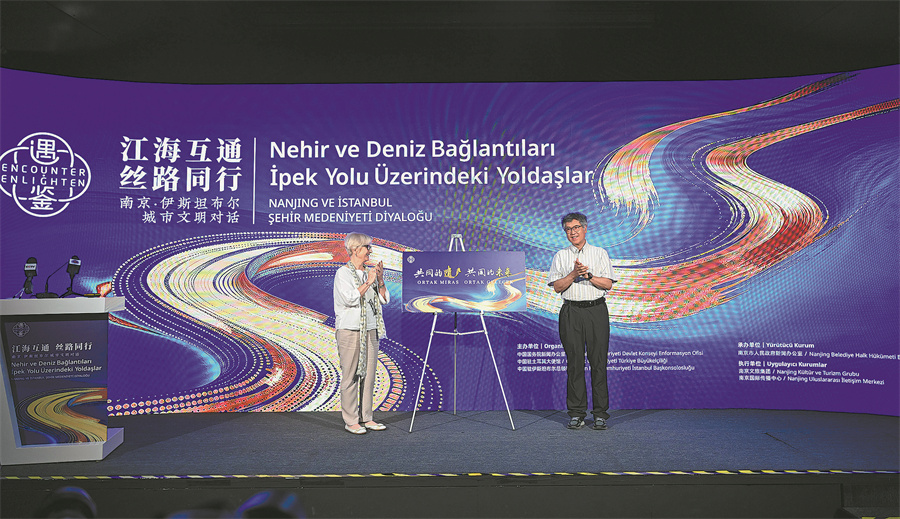
Experts lead a discussion during the Nanjing-Istanbul Urban Civilization Dialogue held in Istanbul, Turkiye, on July 2, 2026. [Photo/Xinhua]
Relations between the Republic of Turkiye and the People's Republic of China have gone through significant phases since the establishment of diplomatic relations in 1971. Turkiye-China relations, actually, date back to centuries. This historical bond forms the foundation of our ever growing diplomatic, economic and cultural ties.
The centuries-long trade along the Silk Road forged a path for cultural interaction between the Turkish and Chinese peoples, leading to many cultural similarities in our daily life rituals and traditional beliefs, especially regarding the importance of family and community.
Interactions between Turkish and Chinese people increased between the Ottoman Empire and Ming (1368-1644) and Qing (1644-1911) dynasties, with many Turkish and Chinese travelers journeying through the Silk Road and emperors exchanging gifts including Ottoman rifles, Chinese porcelain and silk.
In addition to those cultural interactions, both peoples also share similarities in their history. They faced external pressures, changed power balances in the international system and experienced significant transformations throughout the 19th and 20th centuries.
Turkish victory in the War of Independence was hailed by many Chinese intellectuals and political leaders of the time. Communist Party of China leaders such as Cai Hesen stated that the Anatolian victory of the Turkish people against imperialism was a development that would encourage all oppressed nations.
Turkiye has supported China's territorial integrity. Establishment of the diplomatic ties in 1971 marked the beginning of a new era in the Turkiye-China relations.
As both countries underwent processes of opening up to the outside world in the 1980s, the relationship took on a more dynamic character. Mutual contacts increased, political dialogue strengthened, and economic and trade relations gained new momentum.
Our relations have further advanced by the Chinese state visit to Turkiye in April 2000 at the invitation of Turkiye. The Joint Communique signed during the state visit expressed both sides' determination to expand the friendship and mutually beneficial cooperation, while pointing out the need for the restoration of the ancient Silk Road, paving the way for our early support to the Belt and Road Initiative.
Following that mutual visionary approach, today, connectivity is encompassing trade security, supply chains, energy flows and digital networks in our ties. For this reason, Turkiye's Middle Corridor Initiative and China's BRI provide two complementary visions. The will to align the two initiatives shows that two countries can view Eurasian connectivity from a shared perspective.
This joint perspective was underlined by the presidents of the two countries. The shared commitment of our President, H. E. Recep Tayyip Erdogan, and President Xi Jinping to develop bilateral relations provides a strong political foundation for our future. Numerous meetings between the two leaders, the latest being the meeting at the Shanghai Cooperation Organization Tianjin Summit on Aug 31, 2025, constitute a concrete demonstration of this dialogue.
Within the context of this shared vision, our economic relations developed in recent years. Trade volume increased 40-fold in the last two decades, transportation projects multiplied and mutual investments expanded.
While current economic relations unfortunately still do not fully reflect the true potential of both countries, we believe that this can be remedied by investments, tourism and other measures that are at our disposal to have a more fair, balanced, diversified and mutually beneficial relationship.
In this vein, high-quality direct investments from China into our country will create a true win-win foundation for the sustainability of our economic relations, while offering Chinese companies significant advantages in terms of access to markets adjacent to Turkiye.
Airlines connectivity have an important role not only in our economic relations, but in people-to-people contacts as well. Since tourism is the strongest point of convergence in people-to-people ties, increasing frequency of flights to 56 times per week in 2026, strengthens direct connections for tourism, trade and business. Our decision, on the occasion of the 55th anniversary, to grant visa exemptions to Chinese citizens for touristic travel and transit starting on Jan 2, 2026, demonstrates our strong commitment to increasing people-to-people contacts.
Today our world is undergoing a profound transformation. Turkiye and China stand as two ancient civilizations at the heart of this transformation.
In such an atmosphere, Turkiye's commitment to multilateralism and strengthening its relations with China is a natural reflection of our multi-dimensional foreign policy. At a time when conflicts, instabilities and uncertainties are rising, increasing mutual dialogue is more important than ever.
Turkiye-China relations should further develop on this framework. What needs to be done today is to translate this political will into more concrete projects, efficient mechanisms and active private sector participation.
We hope that the 55th anniversary of the establishment of Turkiye-China diplomatic relations will present more opportunities to transform our connection through history into a vision of partnership that is richer, more balanced and more sustainable.
The author is ambassador of the Republic of Turkiye to China.
The views don't necessarily reflect those of China Daily.
If you have a specific expertise, or would like to share your thought about our stories, then send us your writings at opinion@chinadaily.com.cn, and comment@chinadaily.com.cn.
You May Like
-
Interview: China's economic growth to expand BRI, Middle Cor...
China's economic growth creates opportunities to expand the capabilities of the Belt and Road Initiative (BRI) and the Middle Corridor, fostering regional benef...
InKunming 2026-01-30 -
Intl students pledge to be cultural links
Inspired by the Chinese leader's letter, the students highlighted how the message affirmed the value of young voices in international cooperation.
InKunming 2026-01-19 -
Trilateral links will boost growth
Hong Kong venture capitalist Andre Kwok shuttles between the Chinese territory and member states of the Association of Southeast Asian Nations as well as the Gu...
InKunming 2026-01-19 -
Inside China's expanding partnership with Africa
As Belt and Road Initiative projects gather pace across Africa — upgrading transport networks, strengthening energy systems and expanding digital connectivity ...
InKunming 2026-01-15 -
Feature: How 2026 will strengthen China-Africa educational t...
In July 2025, braving Typhoon Co-may's gales, a planeload of 20 Zhejiang Normal University students and teachers landed at Port Elizabeth in South Africa, becom...
InKunming 2026-01-14 -
Azerbaijan's president lauds comprehensive strategic partner...
Azerbaijani President Ilham Aliyev has called his country's comprehensive strategic partnership with China "a great success."
InKunming 2026-01-07 -
China's landmark trade corridor cargo volume hits record hig...
China's New International Land-Sea Trade Corridor rail service handled a record 1.425 million twenty-foot equivalent units (TEUs) of cargo in 2025, marking a 47...
InKunming 2026-01-07 -
Beyond the Great Wall: A French entrepreneur's journey in Ch...
entrepreneur who played a key role in preserving the Great Wall in the 1980s. Over the decades, he has remained deeply engaged with China
InKunming 2025-12-31 -
Yearender: Significant progress made in building China-Indon...
Indonesian Ambassador to China Djauhari Oratmangun fondly recalled the achievements in bilateral relations by 2025.
InKunming 2025-12-26 -
Interview: Global South seeks just, equal seat at world's ta...
A growing sense of justice is motivating Global South nations to become equal architects of the future international system, says Belarusian expert.
InKunming 2025-12-23