Fragile beauty, enduring legacy
Source: China Daily | 2026-04-01 | Editor:Flynn
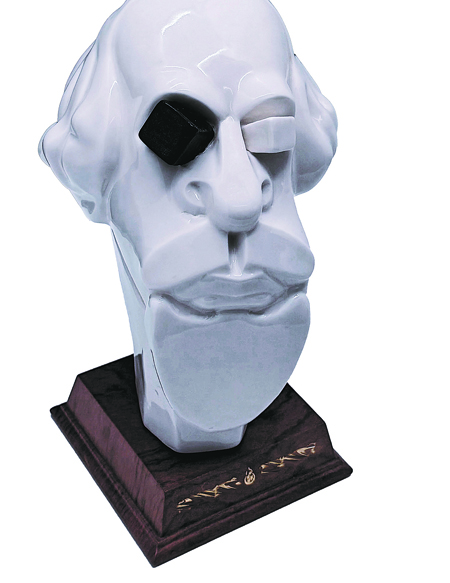
Black and White in Shakespeare's Eyes by Zhang Heirui. CHINA DAILY
Bartosz Turczynski, a 20-year-old Polish student, stood captivated before a glass display case at the Guangdong Museum of Art. He was studying Princess Yushu, a porcelain sculpture with robes so thin they seemed to dissolve into light.
"This is Chinese luxury," he said, marveling at the delicate piece. "Other countries could never replicate this. It's so elegant. The soft, graceful light on it fills me with awe."
The sculpture, created by master ceramic artist Lian Deli, is renowned for its astonishingly intricate details, including translucent clothing and finely carved strands of hair, some measuring just 0.2 millimeters in thickness — "as thin as cicada wings", a hallmark of Dehua porcelain craftsmanship.
"This is the thinnest Dehua porcelain work ever made," Lian said. "It took me nearly seven years and hundreds of failed firings to complete. I had to constantly adjust the clay mixture and carefully control the kiln temperature, which requires extremely precise skill — and a bit of luck."
Dehua porcelain, originating from the ancient ceramic hub of Dehua county in Fujian province, has a legacy spanning more than 3,700 years. Known for its luminous whiteness and technical precision, it has long been regarded as one of China's finest ceramic traditions.
Yet, behind its ethereal beauty lies a craft defined by extreme difficulty. The porcelain artist Zhou Yao explains the complexity.

Lunar Ice Cream Cone by Zhang Heirui. CHINA DAILY
"From a single kiln firing of about 20 pieces, perhaps only one will succeed," he said. "Every step — shaping, carving, drying, and firing — requires absolute precision. Even a slight variation in temperature or structure can cause a piece to crack or collapse."
Despite the painstaking process, porcelain pieces from Dehua remain highly valued for their artistry and rarity. And today, Dehua porcelain is being reinterpreted by a new generation of artists, blending tradition with innovation.
Young artists are pushing the boundaries of the craft while honoring its legacy. Lai Xirong, born after 2000, is one of them.
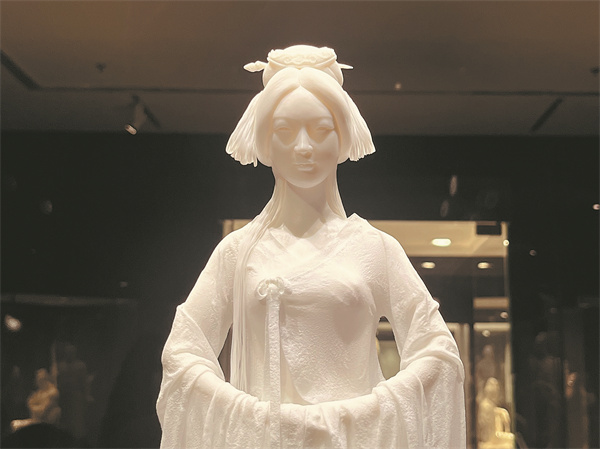
Princess Yushu by Lian Deli. CHINA DAILY
Trained in ceramic design, Lai has become known for her distinct signature: embedding porcelain knots into vessels.
The idea came to her while making an openwork vase, where she felt the cutout spaces were too empty. "I realized that if yarn can be knotted, clay coils can be too," she said.
Lai's work incorporates dense porcelain knots into vessels, a meticulous process requiring precise timing.
"If the clay dries too much, it cracks. If it's too wet, it collapses," she explained.
Her creations range from sculptural works like Knot to functional objects, such as knotted coffee cups and porcelain "instant noodles".
Lai sees her work as a bridge between art and daily life. "Chinese knots carry auspicious meaning. Integrating them into everyday objects makes that meaning tangible," she said.
Her exploration of traditional techniques in modern contexts is an example of how young artists are reimagining Dehua porcelain, connecting it with contemporary sensibilities while maintaining its cultural depth.
Zhang Heirui, 36, comes from a distinguished Dehua ceramic family. Trained by his mother, Chen Minghua, a master of Chinese ceramic arts, Zhang's work blends tradition with the influences of global culture.
His piece, Lunar Ice Cream Cone, turns porcelain into an ice cream cone shaped like the moon, complete with the Jade Rabbit — a charming work that has gained significant attention online.
"I wanted to integrate elements that young people naturally connect with," Zhang said.
However, his work is not limited to whimsical pieces. Black and White in Shakespeare's Eyes is an abstract exploration of William Shakespeare's iconic curly hair, eyes, and the sociopolitical tensions of the Renaissance, reflecting his interest in Western art and contemporary themes.
"It's a response to Western classical culture," Zhang explained. "A way of engaging with it analytically, even critically, while addressing universal questions of human nature."
Zhang's blending of contemporary trends with traditional porcelain techniques has sparked both admiration and critique.
Some traditionalists called Lunar Ice Cream Cone "too playful", and even his mother initially questioned his direction.
"They made me reflect on fundamental questions," Zhang said. "How can contemporary trends coexist with craftsmanship? How can innovation retain cultural depth?"
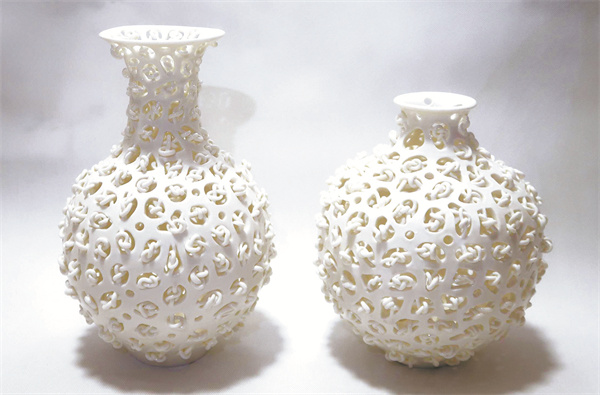
Knot by Lai Xirong. CHINA DAILY
Building on this reflection, Zhang has brought his reinterpretations of Dehua porcelain to the international stage, attracting attention from major museums and collectors. For example, Lunar Ice Cream Cone was acquired by the Tate Modern in the UK, and Black and White in Shakespeare's Eyes by the Centre Pompidou in France.
"Porcelain is no longer just about technical skill," Zhang said."It's about the emotional connection it creates and the way it speaks to contemporary audiences while retaining its cultural roots."
Dehua porcelain's international appeal dates back to the 17th and 18th centuries when it traveled along the Maritime Silk Road to Europe. Known in the West as Blanc de Chine, its pure white aesthetic captivated aristocrats and collectors. But today, it's the innovative interpretations of young artists that are bringing Dehua porcelain to a new global audience.
"Tradition is not something to break away from," Zhang said."It's a foundation to build on."
You May Like
-
Traditional culture shines as festive travel surges during S...
More than halfway through China's nine-day Spring Festival holiday, which began on Feb. 15, travel enthusiasm shows no signs of slowing.
InKunming 2026-02-24 -
Chewy rice cakes embody wishes for good fortune
On festive kitchen counters, fish will flick their tails in mid-motion, gold ingots will sit plump and round, and a square "gold brick" will stand firmly at the...
InKunming 2026-02-11 -
Where to See Plum Blossoms in Kunming This Winter
While snow still blankets northern lands, the branches of Kunming, known as the “Spring City,” are already in bloom. In a city where flowers can be found year...
InKunming 2026-01-27 -
Across China: SW China's ancient Tea Horse Road finds new li...
After years of living in China, Antonio from Spain discovered a new passion in the intricate world of tea, noting that his trip through Yunnan in southwest Ch...
InKunming 2026-01-23 -
From balance beam to screen
Olympic champion Guan Chenchen has made her screen debut in The Secret to Fat Loss, China's first costume micro-drama centered on scientific fitness, which offi...
InKunming 2026-01-21 -
Bamboo slips tell stories of ancient eras
The Jingzhou Cultural Relics Protection Center has developed core technologies to tackle the challenges in restoring waterlogged bamboo and wooden slips, and un...
InKunming 2026-01-15 -
Stitch by Stitch: Jin Huizhen’s Half-Century Devotion to Tr...
In a quiet home in Chenggong District, sunlight streams through the windows onto the balcony. Seated at a table, Jin Huizhen, a recognized inheritor of Chenggon...
InKunming 2026-01-12 -
Global dialogue as fine as porcelain
Artists of Dehua county receive support in their works going overseas, as they innovate the centuries-old craft known as 'ivory white'.
InKunming 2026-01-09 -
Tomb rekindles Chu history
Lavish burial reveals monarchy's splendor, vulnerability and struggles on the eve of imperial unification.
InKunming 2026-01-09 -
Dong New Year traditions are a major attraction
To the rhythm of lusheng woodwind pipes and the scent of sticky rice cakes, a village in southwest China's Guizhou province celebrated its annual Dong Ethnic Ne...
InKunming 2025-12-31