Neighborhood spurs tourism with immersive experience
Source: China Daily | 2026-03-24 | Editor:Flynn
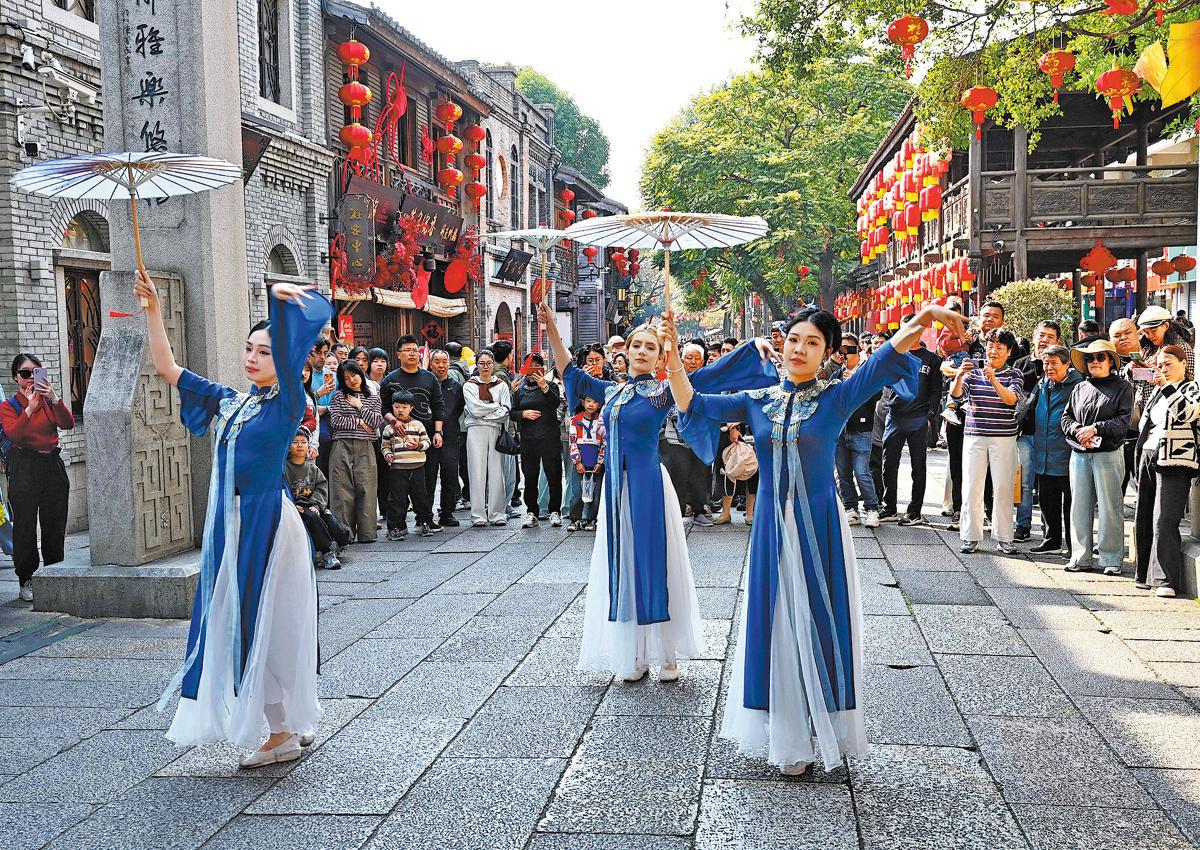 Dancers perform in the Sanfang Qixiang neighborhood in Fuzhou, Fujian province, in February. LIN SHANCHUAN/XINHUA
Navigating the ancient stone corridors of Sanfang Qixiang — a well-preserved historical neighborhood in the heart of Fuzhou, capital of Fujian province — 26-year-old Xu Qing from Shanghai feels as if she has stepped through a portal.
Dressed in elegant attire of the Qing Dynasty (1644-1911), she wears the "Three-Sword Hairpins", a silver ornament. Its sword-like blades once symbolized the resilience of local women and their commitment to protecting their families.
"Walking through these courtyards in this attire, I feel a profound connection to the historical figures who once lived here," Xu said. "Their stories are no longer just pages in a textbook."
This experience is part of a broader effort in Fuzhou to restore its historical buildings. By turning ancient residences into interactive spaces, the city has created new opportunities for a generation of visitors.
Known literally as the Three Lanes and Seven Alleys, this architectural complex once housed over 400 figures who shaped modern China, earning it the reputation as "a window into half of China's modern history".
Historical residents included Lin Zexu (1785-1850), who led the movement against the opium trade; Yan Fu (1854-1921), the scholar who translated Darwin's evolution theories; and Shen Baozhen (1820-1879), a key figure in China's early modern navy.
The neighborhood was also home to Lin Juemin (1887-1911), who was executed for his revolutionary role at 24. His Letter of Farewell to My Wife, written shortly before his death, remains widely preserved in China's historical records.
Today, these stories are being retold through new displays designed to engage modern audiences.
Crowds now visit the museum honoring Lin Huiyin (1904-1955), which began trial operations this February.
As an alumna of the University of Pennsylvania, Lin, whose ancestral home was in the lanes, is celebrated globally for her architectural work.
Inside, visitors linger to hear original audio recordings of Lin's close friend, while a hand-sewn qipao (traditional Chinese women's dress) by her and her letters from the World War II era are on display.
Tong Junwen, an overseas professional from Toronto, left a note after her visit in March, "As someone who studied and now works abroad, I felt a connection to Lin's experience."
"Seeing her journey in a foreign land reminded me that students across generations face similar questions — how to choose a path in a new cultural environment," Tong added.
Nearby, the legacy of General Wu Shi (1894-1950), an underground worker born in Fuzhou who died in Taiwan, has gained attention following the success of the TV drama Silent Glory last year.
His life is now portrayed through an immersive play staged within an ancient courtyard in the alleys, which has moved over 8,700 spectators since November.
Local entrepreneur Wu Bixia, who opened a photography studio in the district, said that this trend reflects a "cultural awakening" among the younger generation.
Driven by this massive tourism growth, her studio served nearly 100 customers daily during the recent Spring Festival.
According to local authorities, the district welcomed over 104 million visitors from 2021 to 2025, providing a significant boost to Fuzhou's service economy.
Currently on the UNESCO World Heritage Tentative List, Sanfang Qixiang is working toward full designation by reviving the traditions that define the city's soul.
You May Like
-
"A very Chinese time," and why it resonates globally
In a few days, the Spring Festival will bathe cities and villages in the warm glow of red lanterns. Across China, hundreds of millions will gather at home to ...
InKunming 2026-02-13 -
Young travelers chase authentic Spring Festival vibes in sma...
China's upcoming nine-day Spring Festival holiday, the longest on record, is doing more than unleashing pent-up travel demand. It is revealing a clear shift amo...
InKunming 2026-02-10 -
Across China: Novel coffee experiences brew new, elevated to...
Suspended on a cliff face over 200 meters high, a café in the dense forests of Libo County, southwest China's Guizhou Province, serves premium coffee with a d...
InKunming 2026-02-09 -
Where to See Plum Blossoms in Kunming This Winter
While snow still blankets northern lands, the branches of Kunming, known as the “Spring City,” are already in bloom. In a city where flowers can be found year...
InKunming 2026-01-27 -
Fair featuring intangible cultural heritage, Chinese New Yea...
A citizen views paper-cutting works during a fair featuring intangible cultural heritage and Chinese New Year goods in Hangzhou, east China's Zhejiang Province,...
InKunming 2026-01-26 -
History on the plate
Why do Chinese people eat dumplings during the winter solstice? Was egg-fried rice once considered a dish reserved for emperors?The answers to these questions c...
InKunming 2026-01-23 -
From balance beam to screen
Olympic champion Guan Chenchen has made her screen debut in The Secret to Fat Loss, China's first costume micro-drama centered on scientific fitness, which offi...
InKunming 2026-01-21 -
China Focus: Southeast Asian tourists flock north, fueling C...
Despite the biting minus 20 degrees Celsius cold on the century-old Central Street in Harbin, northeast China's Heilongjiang Province, Thai tourist Nattapong ...
InKunming 2026-01-20 -
Ice dragon boat race aims to bolster Sino-UK bond
The frozen Songhua River in Harbin, Heilongjiang province, came alive with the sound of drums and the rhythmic clanging of ice picks, as nearly 200 members of i...
InKunming 2026-01-13 -
Stitch by Stitch: Jin Huizhen’s Half-Century Devotion to Tr...
In a quiet home in Chenggong District, sunlight streams through the windows onto the balcony. Seated at a table, Jin Huizhen, a recognized inheritor of Chenggon...
InKunming 2026-01-12