China Focus: China unveils undersea drilling robot to boost deep-sea exploration
Source: Xinhua | 2026-01-16 | Editor:Doe
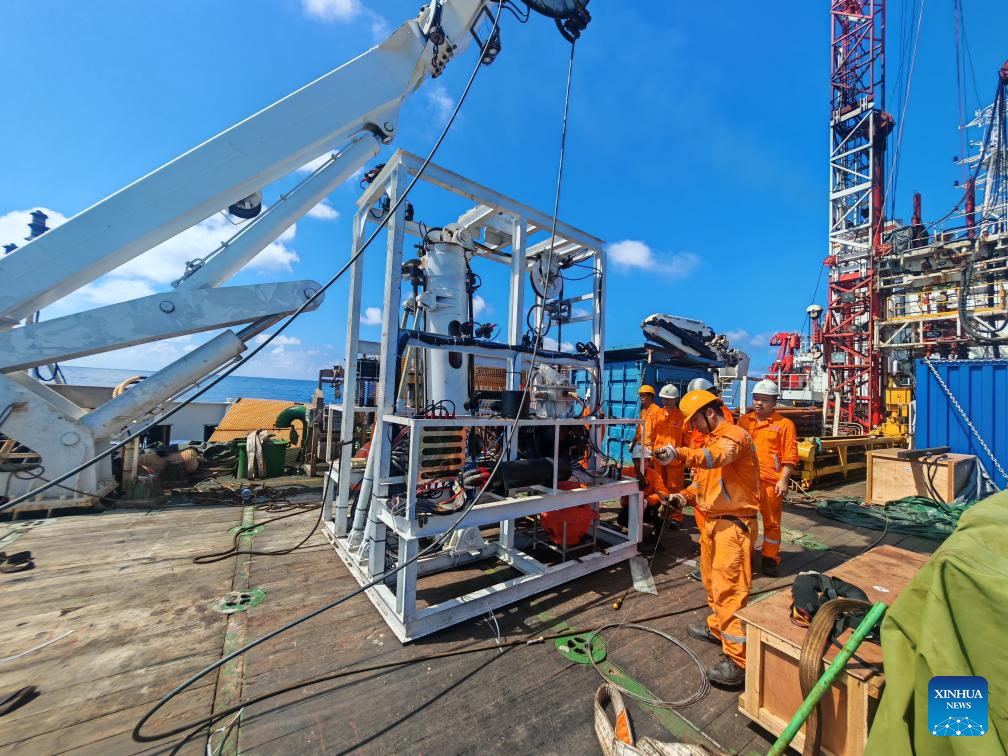
Staff members prepare the trial operation of China's first domestically developed undersea robot capable of three-dimensional drilling and in-situ monitoring within seabed strata in the South China Sea, Oct. 14, 2025. (Guangzhou Marine Geological Survey/Handout via Xinhua)
China's first domestically developed undersea robot capable of three-dimensional drilling and in-situ monitoring within seabed strata has successfully completed a trial operation in the South China Sea at a depth of 1,264 meters.The robot, developed by the Guangzhou Marine Geological Survey (GMGS) under the China Geological Survey, achieved all performance targets during the recent mission, marking a significant breakthrough in the country's deep-sea exploration and in-situ formation monitoring capabilities, the GMGS said on Wednesday.
"It can drill freely and position itself accurately inside deep-sea formations, autonomously avoiding obstacles such as rocks and biological debris while dynamically planning optimal paths," said Zhu Yangtao, a GMGS engineer and deputy leader of the robot project.
"Equipped with multiple sensors, it can also conduct long-term, wide-coverage, multi-parameter in-situ monitoring deep within the strata."
During the trial, the robotic system conducted real-time in-situ monitoring of target seabed formations, capturing more than 2,000 data sets on methane concentration, dissolved oxygen, and stratigraphic structure, said Zhu.
"The data obtained will help us better understand the geological conditions of the test extraction zone," he said.
Deep-sea strata contain crucial resources such as gas hydrates, deep-sea rare-earth elements, and polymetallic nodules. Their safe and sustainable development is vital to national energy and resource security. However, exploration is challenged by extreme conditions, including low temperatures, high salinity, extreme pressure, and geological instability.
Existing deep-sea drilling and monitoring technologies often lack mobility, sufficient spatial and temporal coverage for in-situ observation, and real-time data transmission, explained Zhu.
These shortcomings have hindered the industry's ability to perform low-disturbance, real-time in-situ monitoring inside seabed formations, which is in growing demand for deep-sea resource development, said the engineer.
To address these gaps, the GMGS research team independently developed key technologies and built the robot. It adopts a modular multi-section design and integrates inertial navigation, magnetic beacon-assisted positioning, and AI algorithms, significantly improving its intelligence and environmental adaptability.
Looking ahead, the team will further enhance the robot's overall performance to adapt to more complex working environments. It is expected to be deployed in the exploration and development of deep-sea resources, including gas hydrates, rare-earth elements, and polymetallic nodules.
The robot will also support China's deep-sea scientific drilling projects, providing key technological support for the national deep-sea science strategy and the building of a strong maritime country, noted Zhu.
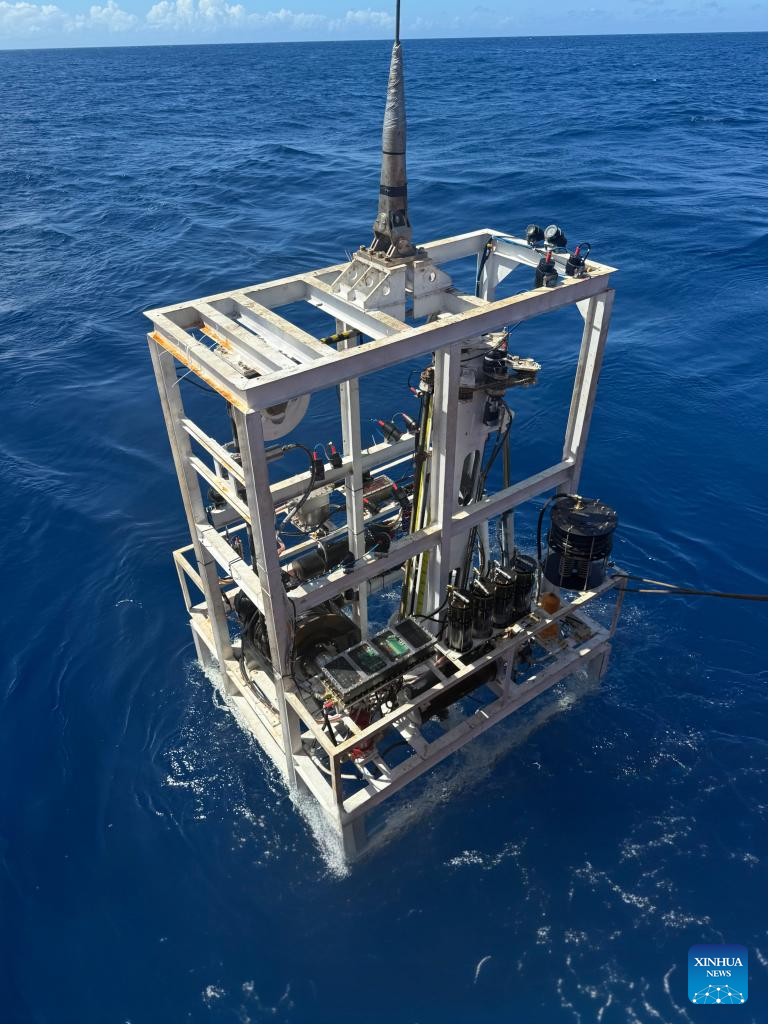
This photo taken on Oct. 14, 2025 shows China's first domestically developed undersea robot capable of three-dimensional drilling and in-situ monitoring within seabed strata in the South China Sea. (Guangzhou Marine Geological Survey/Handout via Xinhua)
You May Like
-
EcoChina | Local farmers combat desertification in Moyu Coun...
Desertification prevention-and-control, one of the top-priority missions in Xinjiang for many years, offers extra job opportunities for local farmers in the sla...
InKunming 2026-01-13 -
Chinese FM says it's opportune time for China, AU to enhance...
Chinese Foreign Minister Wang Yi said Monday that it is the opportune time for China and the African Union (AU) to enhance strategic mutual trust and deepen str...
InKunming 2026-01-13 -
Celebrating 60 years of scientific archaeology in China
In 1959, Chinese archaeologist Xia Nai handed researchers Qiu Shihua and Cai Lianzhen a copy of "Radiocarbon Dating," a book by American scientist Willard F. Li...
InKunming 2026-01-13 -
China Focus: China maps cotton's evolutionary secrets to bui...
Chinese scientists have constructed the most comprehensive genetic map of the world's primary cotton crop to date.
InKunming 2026-01-12 -
China to expand services sector opening-up pilot program to ...
China will advance the opening-up of its services sector in nine additional pilot cities, according to a statement released by the Ministry of Commerce on Frida...
InKunming 2026-01-12 -
Economic Watch: From lab to market, China accelerates fronti...
From robots deployed at airports and hotels to autonomous vehicles navigating city roads and quantum computing tackling complex industrial calculations, innovat...
InKunming 2026-01-12 -
China to accelerate building data property rights registrati...
China will move faster to establish a data property rights registration system, as part of the efforts to promote the use of data and unlock its value, accordin...
InKunming 2026-01-12 -
From lab to market, China accelerates frontier tech deployme...
From robots deployed at airports and hotels to autonomous vehicles navigating city roads and quantum computing tackling complex industrial calculations, innovat...
InKunming 2026-01-12 -
China-Austria winter carnival kicks off in Shanxi
The 2nd China-Austria Ice and Snow Culture Carnival kicked off on Tuesday in Lingchuan county, Jincheng, Shanxi province, tapping into the growing enthusiasm fo...
InKunming 2026-01-09 -
China's landmark trade corridor cargo volume hits record hig...
InKunming 2026-01-09