Every Tree Is Tenderly Cared For—Nobel Laureate Dan Shechtman’s Impressions of Kunming
Source: InKunming | 2025-12-25 | Editor:Rachel
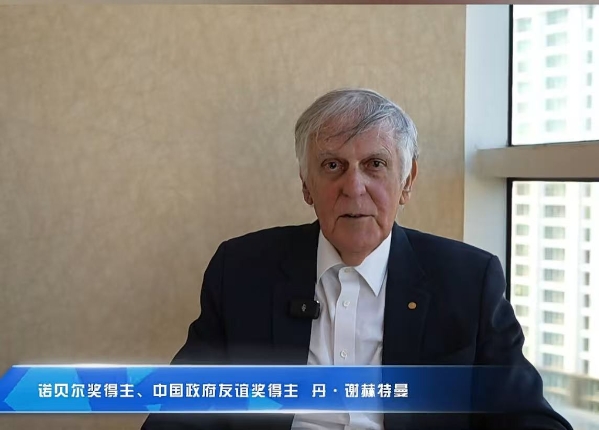
Dan Shechtman, Nobel Chemistry laureate and newly elected foreign academician of the Chinese Academy of Sciences.
“There are so many trees here—each one lush, full, and so carefully tended.”
Twelve years after his first visit to Kunming, Nobel Chemistry laureate and newly elected foreign academician of the Chinese Academy of Sciences, Dan Shechtman, once again walked the streets of the “City of Eternal Spring.” What he saw moved him to this spontaneous remark.
This was no polite pleasantry. It was the precise observation of a scientist who has seen cities around the world and weighs his words carefully. To him, the thriving trees were not merely scenic—it was the clearest expression of a city’s philosophy of development.

With rolling peaks, lush forests, and birdsong echoing through the valleys, Xishan Scenic Area is a verdant forest park of remarkable natural beauty.
A City’s Promise to Every Tree, and to Its Future
“I saw so many trees. People in Kunming truly cherish and care for every single one. They plant them with devotion and maintain them with great care. I’ve never seen such a consistent and heartfelt effort anywhere else in the world,” Shechtman said.
What impressed him even more was the logic underpinning this widespread practice: “If a city can take each tree so seriously, that in itself is an impressive commitment. It shows a deep sense of responsibility toward urban development and its future.”
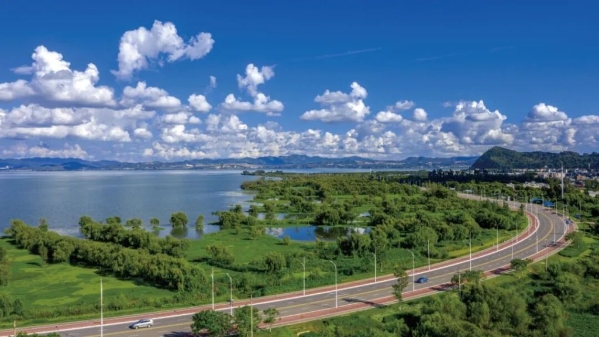
Picturesque scenery unfolds along the southern shore of Dianchi Lake. Photo by Li Jiming
His words captured the essence of Kunming’s environmental philosophy—an almost stubborn precision and patience. The city’s greenery is not the product of campaigns or slogans; it reflects a belief that each tree is a living citizen deserving a full life cycle of care. From willows by Cuihu to redwoods along the Panlong River, from small pocket parks to the woods atop Xishan, this quiet, consistent devotion has created a living, breathing green foundation for the city.
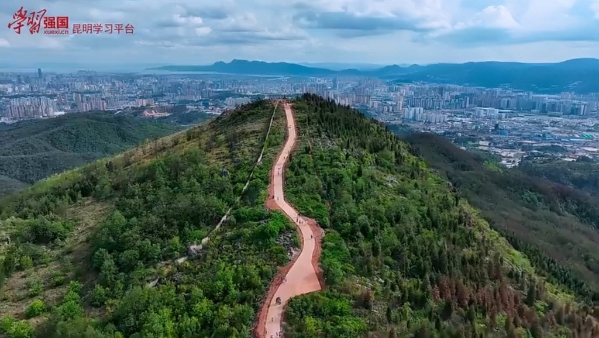
Aerial view of Changchong Mountain. Photo from the Kunming Learning Platform of "Xuexi Qiangguo".
Caring for a tree requires not only funding and expertise but also foresight and respect for nature. This "commitment" is precisely the underlying code of Kunming’s response to the question of how to achieve true development.
Finding a Balance Between Growth and Preservation
When Shechtman climbed Xishan Mountain again twelve years later, he found a Kunming that had learned to balance progress with preservation.
“From Xishan Mountain, you can survey the entire city. The fusion of new and historic structures is interwoven with ecological landscapes. While roads are more extensive and buildings grander, this development harmonizes with the beautiful natural scenery.”
What has changed is the city’s skyline, its expanded infrastructure, its growing scale—inevitable signs of development and the pulse of modernization.
What remains unchanged are the shimmering waters of Dianchi Lake, the verdant slope of Xishan Mountain, and the harmony between city and nature. These form Kunming’s roots—the irreplaceable DNA of Kunming.
Rare and commendable is this harmonious coexistence. It signifies development that is not about demolition and rebuilding or the erosion of nature, but about allowing the new and the historic to dialogue and meld within an ecological framework. This capacity for integration tests the wisdom and resolve of urban planners.
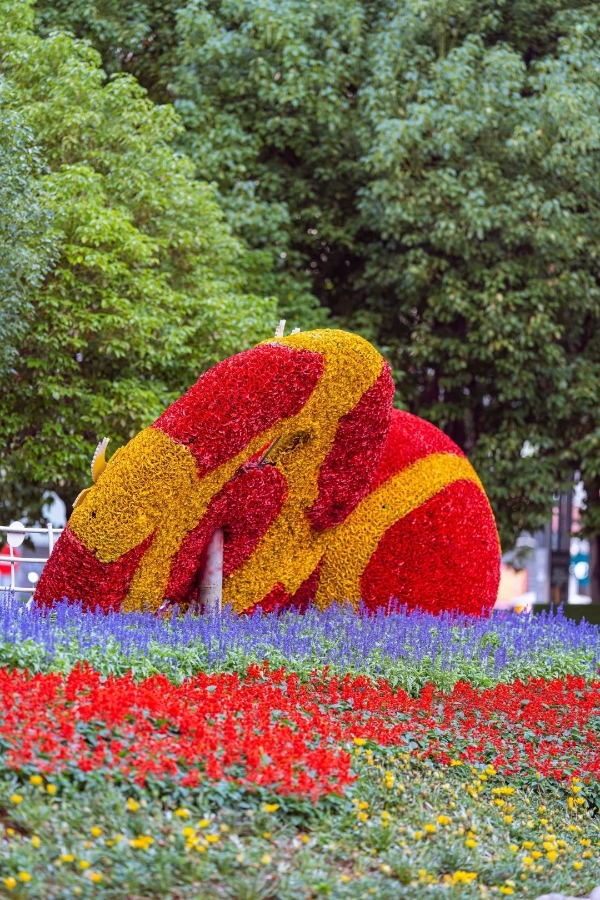
In Wuhua District, Kunming, vertical flower beds along urban roadsides have beautified the cityscape, improved the environment, and enriched citizens’ aesthetic experience—adding a refined touch to the city’s character.
Thoughtful Design Enhances a Natural Wonder
At the World Natural Heritage Site of the Stone Forest, Shechtman’s attention extended beyond the striking shapes of karst pillars.
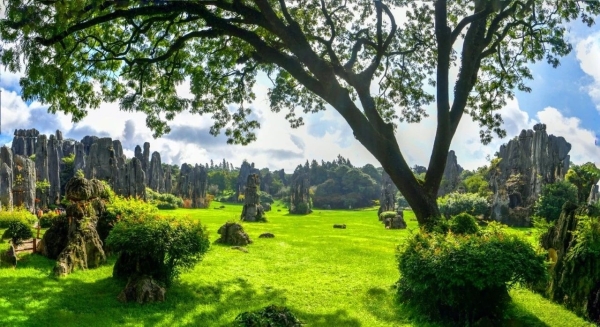
The Stone Forest of Kunming—a place named for its stones and famed because of them.
“The Stone Forest is magnificent.Its trail system is exceptionally well-developed and perfect for walking tours. During my visit, I observed horticulturists meticulously tending to the landscape. This vividly demonstrates the planners' skill in merging natural marvels with the visitor experience.”
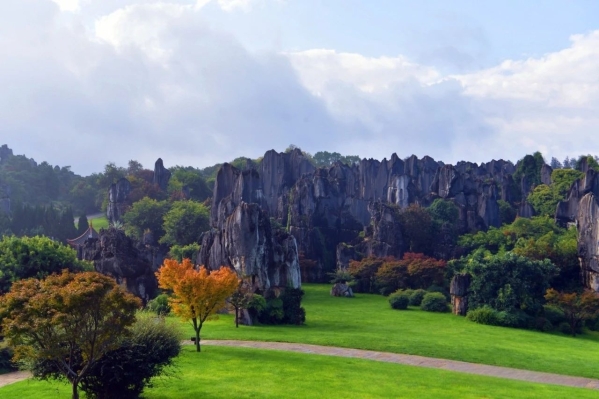
In autumn, the Stone Forest is at its most serene and graceful—clear skies, crisp air, and boundless beauty.
Nature granted the Stone Forest its dramatic forms; Kunming’s planners, through careful trail design and ongoing maintenance, made that gift accessible, experiential, and enduring. The lesson is clear: the best preservation is not isolation, but engagement—a way to connect people deeply to nature through thoughtful, science‑based design. That very capacity for integration is what turns natural assets into lasting public good.
Livability is the Most Persuasive Form of Progress
“The air here is fresh; the climate, pleasantly mild.” Shechtman repeatedly voiced his admiration for Kunming’s environment. His overall impression: “I see diversity and balance in the city’s development—modern construction alongside abundant natural resources, verdant landscapes, and beautiful lakes and mountains. It is a truly livable city.”
Livability is one of the highest goals a city can pursue—a synthesis of clean air, mild weather, convenient facilities, and beautiful scenery. The diversity and balance Shechtman sensed reflect Kunming’s ongoing quest to find its golden ratio between steel and green, between rapid growth and tranquil living.

With an abundance of fresh ingredients, a rich and mellow broth, and meticulous presentation, the iconic “Crossing-the-Bridge Rice Noodles” exemplify the essence of Yunnan cuisine. In the rising steam lies not only the fragrant freshness of local ingredients, but also the heritage and innovation of Yunnan’s culinary culture. Photo by Su Wenqian
This livable experience ultimately translated into the most genuine endorsement:“I will recommend this place to friends, family, and travelers.” He not only passionately sampled local delicacies like crossing-the-bridge rice noodles and explored city landmarks with the spirit of a tourist, but also explicitly stated, "If I have the opportunity, I would eagerly return to Kunming. I would unhesitatingly recommend it to my friends and to travelers worldwide, as it is indeed an ideal travel destination."
From his micro‑observation of “every tree being carefully tended” to his macro‑appreciation of the city’s “diversity and balance,” Shechtman’s visit offers a scientist’s clear‑eyed, outsider’s view of Kunming.
His praise is more than recognition of Kunming’s ecological achievements—it affirms a deeper belief: when a city treats every patch of green as a living being, what it earns is not only lush scenery but a sustainable future and genuine applause from the world.
Perhaps this is Kunming’s most vivid answer to the world—a living testament to the harmonious coexistence of humanity and nature.
You May Like
-
French sinologist Yin Dongming: Spring Festival is a window ...
In a French restaurant in Kunming sat a foreigner with brown hair and blue eyes, wearing a very eye-catching ethnic necklace. She is Yin Dongming (Dorothée Riha...
InKunming 2023-01-30 -
Dwight's adventurous and curious "life experiments" in Kunmi...
Press the "play" button! The crackling rock music was on. Dwight Goldwinde started an improvised dance and invited the people sitting nearby to dance with him. ...
InKunming 2022-07-29 -
Filipino Bam finds ideal life in Kunming
Kunming is Bam's home in China. He found his ideal life here, which is to do what he loves and love what he does.
InKunming 2022-05-27 -
Beautiful but not delicate, bustling but gentle: Kunming in ...
“…… All the past and gone, for truly great men, look to this age alone.” Accompanied by Tra My’s sound of reading, her story in Kunming has not come to an ...
InKunming 2022-01-12 -
Poetic and Picturesque Yunnan seen through Thierry's lens
Born in a small town in the south of France, Thierry had worked as a CFO in an international fashion company in New York. According to him, his daily work was m...
InKunming 2021-12-14 -
Ксюша: coming to Yunnan, the best trip I’ve ever had
“Ксюша, things have changed, the university you're going to is on the mountain." In 2013, Ксюша was supported by the Confucius Institute in Ukraine t...
InKunming 2021-12-03 -
Linden tells Xizhou stories to the world perfectly
Brian Linden, who is a Chicago native, has been living in Xizhou, a town in Southwest China for 16 years, attempting to promote a sustainable model of tourism a...
InKunming 2020-08-24 -
Goto Hiroto records the beauty of ethnic costumes with his c...
Goto Hiroto has an ear-reaching centre parting, wears a pair of frameless glasses, a pink pinstripe shirt and cream-colored slacks, which make an impression of ...
InKunming 2020-07-23 -
Patrick Nijs, a former ambassador farming in Dongchuan
Wearing a straw hat and carrying a hoe, he is a tall English speaking “farmer” in Dongchuan. While he has changed his clothes from the former suit and a neckt...
InKunming 2020-05-31 -
Niyontezeho Guillaume: understand China’s power and spirit ...
Recently, InKunming received a letter from Niyotezeho Guillaume (Chinese name: Lu Yiyang), a Rwandese studying at Southwest Forestry University. Like many peopl...
InKunming 2020-02-28