Cliffside wonders elevate tourism in east China
Source: Xinhua | 2025-05-27 | Editor:Jennifer
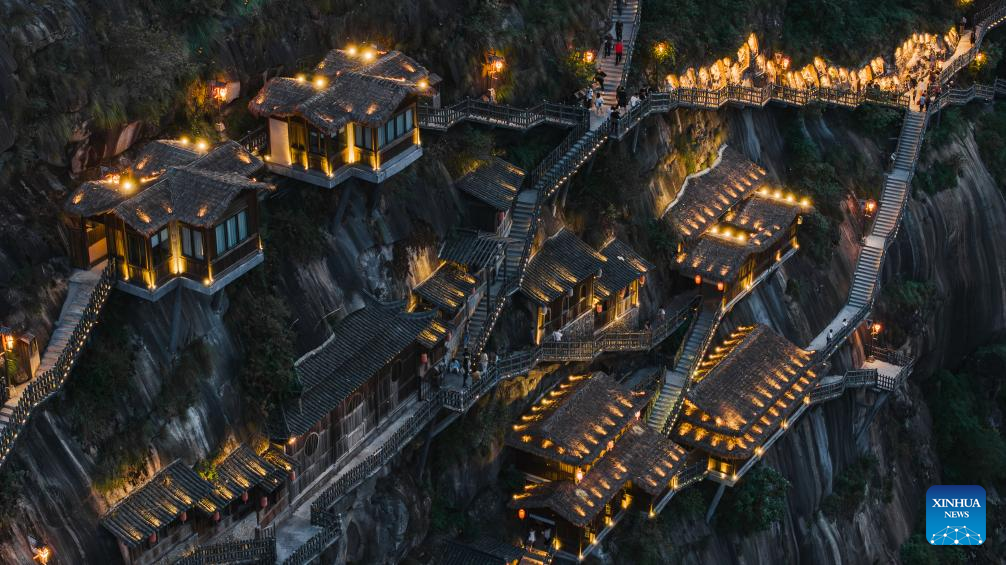
An aerial drone photo taken on Sept. 5, 2024 shows a night view of the Wangxian Valley Scenic Spot in Shangrao City, east China's Jiangxi Province. (Xinhua)
Imagine standing on a balcony at night, the ground disappearing into a dark abyss below while a pattern of glittering stars stretches endlessly across the sky canvas above. This breathtaking scene is a reality at a cliffside hotel in east China.
"It was a thrilling and romantic experience I'll never forget," said a guest surnamed Zhang, who recently stayed at the hotel located in the Wangxian Valley Scenic Spot in Jiangxi Province.
Once a granite mining quarry where villagers had lived and worked, Wangxian Valley has been transformed into a popular tourist destination following a government ban on disorderly mining, with its natural cliffs creatively repurposed into attractions such as cliffside hotels, cliff skywalks and waterfalls.
Thanks to its ethereal and mystical views, this valley has garnered wide attention online. The hashtag "Wangxian Valley" has racked up approximately 3.23 billion views on the Chinese short-video sharing platform Douyin. In the first quarter of 2025, the valley hosted 615,800 visitors, generating 120 million yuan (about 16.71 million U.S. dollars) in revenue.
This tourism boom has also benefited surrounding villagers. Many of them have opened shops and restaurants within the scenic area, while others have found jobs such as waiters and cleaners.
The success of Wangxian Valley exemplifies Jiangxi's efforts to tap into its rich mountainous and hilly landscapes -- accounting for over 70 percent of the province's land area -- by developing distinctive "cliff" tourism.
"Cliff-themed scenic spots not only offer tourists unique and immersive experiences, but also enhance Jiangxi's cultural tourism appeal," said an official from the provincial cultural and tourism department.
A similar transformation has taken place in Huangling Village in Jiangxi, where homes and terraced fields form part of the mountainside views. Due to inconvenient transportation, most residents opted to relocate to the foot of the mountain, and the village there was soon renovated into a scenic area.
The traditional local scene of drying crops on bamboo trays in autumn, known as Shaiqiu, has been reimagined as a tourism trademark. Vast terraced fields have been planted with rapeseed flowers, while the once dilapidated Huizhou-style cliffside buildings have been turned into homestays.
"The homestay offers a 'window-to-scenery' experience. During spring, when the rapeseed flowers are in full bloom, it feels like tourists are waking up in a sea of blossoms," said Cheng Hong, a staff member at Huangling scenic spot.
Meanwhile, cliff shuttle trains began operating earlier this year in the Dajue Mountain Scenic Area in Jiangxi. Notably, a third of the 11.8-kilometer train route runs directly along a cliff.
Passengers can enjoy a "hanging" experience in the air and are treated to sweeping views of canyons, dense forests, seas of clouds and cliffs adorned with blooming rhododendrons.
"It's the least physically demanding mountain climbing experience," commented one visitor.
Since its launch, the cliff train service has welcomed 184,700 passengers, including over 50,000 during the 2025 May Day holiday period.
China continues to promote tourism tailored to local strengths by leveraging resources such as geographical diversity and culture. Data from the Ministry of Culture and Tourism showed that total domestic tourism expenditure had reached 1.8 trillion yuan in the first quarter this year, with 1.79 billion domestic trips made during this period.
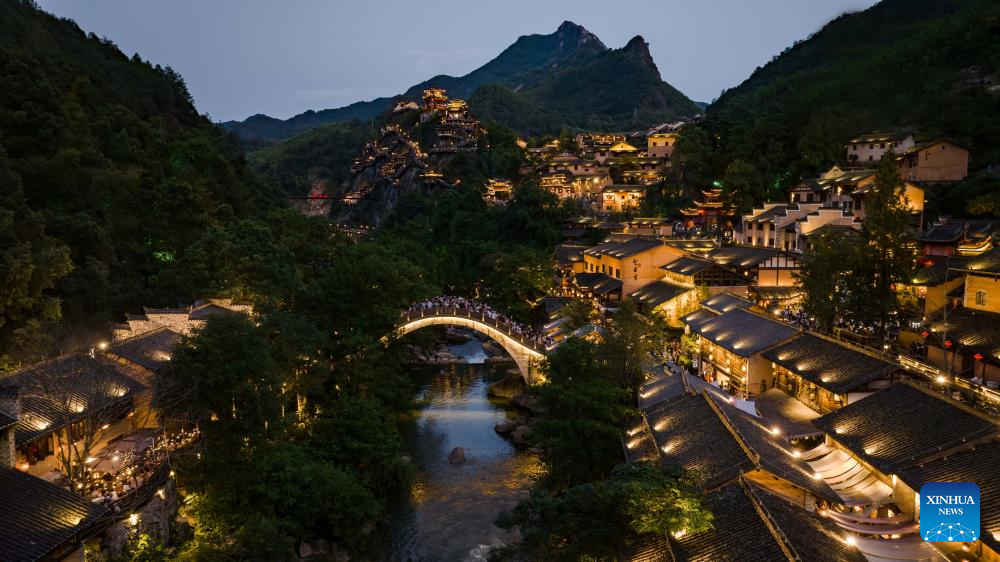
An aerial drone photo taken on Oct. 4, 2024 shows a night view of the Wangxian Valley Scenic Spot in Shangrao City, east China's Jiangxi Province. (Xinhua)
You May Like
-
China's tourism heats up for early summer
China's tourism heats up for early summer
InKunming 2025-05-22 -
Cultural tourism brings vitality to Gulongba Village
In early spring, the Gulongba villagers' group in Fuba Village, Shangjiang Town, Lushui City, embracing the mountains, is picturesque: the land is vast and open...
InKunming 2025-03-11 -
Young Chinese find niche in inbound tourism
Young Chinese have developed new business avenues on the side, such as teaching Chinese, Chinese name-giving and foreign language tour guides, fueled by the gro...
InKunming 2025-02-21 -
Snow tourism turns Erhe into wonderland
On the fourth day of the Year of the Snake, red lanterns adorned a small village in China's northernmost region, drawing thousands of visitors to celebrate Spri...
InKunming 2025-02-05 -
China's Xizang spends heavily on cultural tourism developmen...
Since 2021, Southwest China's Xizang autonomous region has spent 20.16 billion yuan ($2.83 billion) on cultural tourism infrastructure, national park conservati...
InKunming 2024-10-23 -
Cross-border tourism on the right track
New transport option allows travelers the opportunity to view the sights of Laos from the comfort of a high-class train, Yang Feiyue reports.
InKunming 2024-10-14 -
Exploring culture-tourism integration in museums
All this suggests the cultural tourism sector is showing strong recovery, which in turn has accelerated culture-tourism integration.
InKunming 2024-10-12 -
Destination of growth for outbound tourism
After a challenging period, travelers again head for foreign climes.
InKunming 2024-09-20 -
Across China: Historic buildings revitalized with new busine...
In the Pingjiang Road historical and cultural block in Suzhou, east China's Jiangsu Province, tourists are enjoying afternoon tea while savoring the beautiful s...
InKunming 2024-09-09 -
Chinese youngsters embrace more diversified tourism options
China's tourism market is upgrading and becoming a strong source of economic growth. Neo-Chinese style tourism, county tourism, and cultural and immersive exper...
InKunming 2024-05-20